
Quick Summary
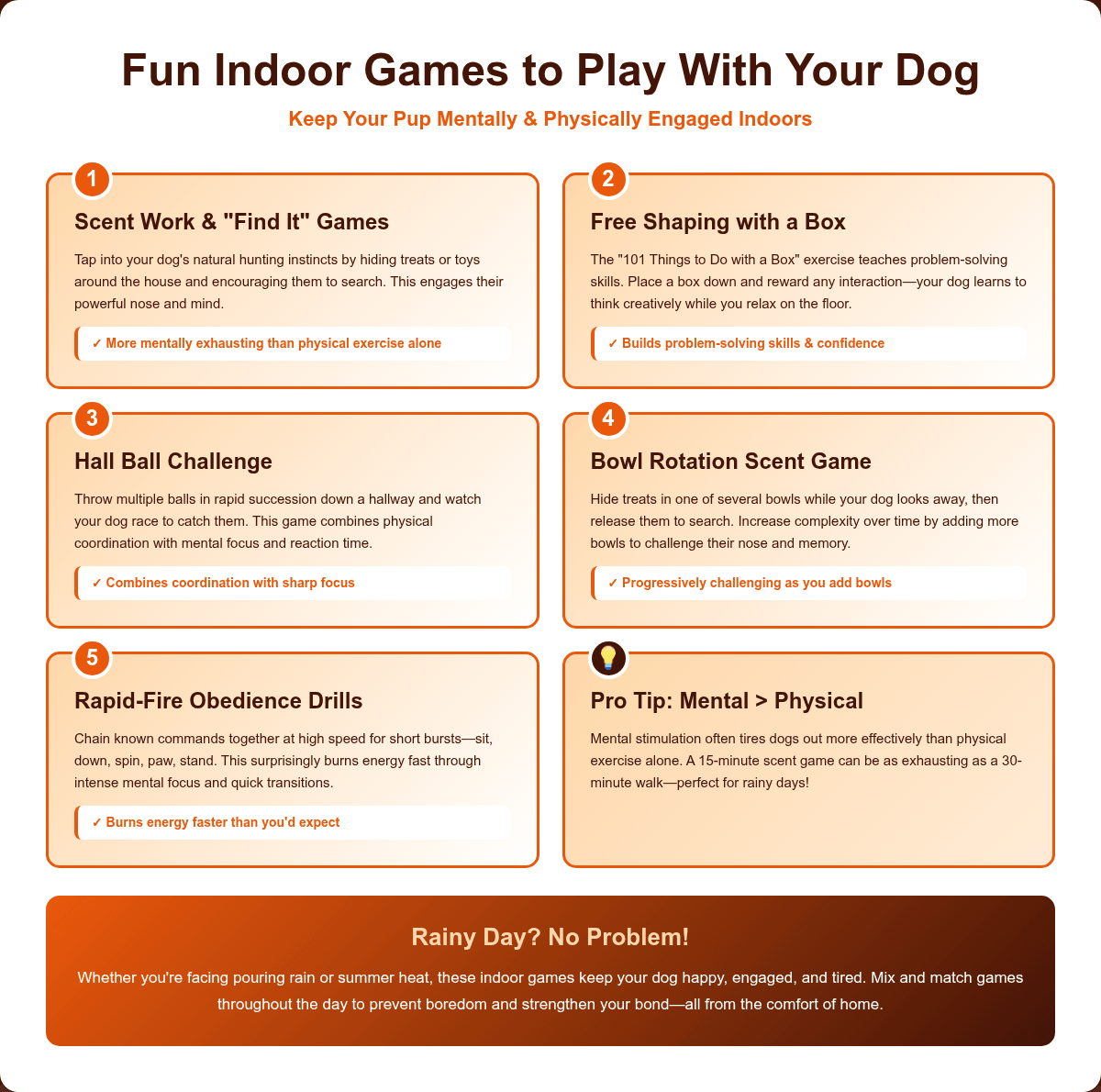
- Scent work and “find it” games tap into your dog’s natural hunting instincts and provide significant mental exhaustion—often more tiring than physical exercise alone
- Free shaping with a box (the “101 Things to Do with a Box” exercise) teaches problem-solving skills while you relax on the floor, using clicker training or verbal markers
- Hall ball challenges your dog to catch multiple balls thrown in rapid succession down a hallway, combining physical coordination with focus
- Bowl rotation scent games involve hiding treats in one of several bowls while your dog looks away, then releasing them to search—adding complexity by increasing the number of bowls over time
- Rapid-fire obedience drills burn energy surprisingly fast by chaining known commands together at high speed for short bursts
Overview
We’ve all been there—staring out at pouring rain or wilting in summer heat while your dog bounces off the walls with pent-up energy. Whether you live in an apartment, face weeks of bad weather, or simply have one of those days when you’re tapped out but your working breed is just getting started, you need reliable indoor games for dogs that actually tire them out. The challenge isn’t just burning physical energy; it’s engaging that restless brain that was bred to herd sheep, retrieve game, or solve complex problems all day long.
The good news is that mental stimulation often exhausts dogs more effectively than another lap around the block. When you’re sitting on your living room floor in your pajamas and your border collie is giving you those expectant eyes, you don’t need to feel guilty about skipping the park. With the right indoor activities, you can provide the enrichment your dog craves while keeping your sanity and your furniture intact.
The Best Indoor Games for Dogs
Scent Work and Interior Searches
Your dog’s nose contains up to 300 million olfactory receptors compared to your measly 6 million, which makes scent-based activities incredibly fulfilling for them. According to research from the American Kennel Club, nose work exercises can tire a dog as effectively as a long walk because of the intense mental focus required.
Start with basic “find it” games where you hide treats around a single room while your dog waits in another area. Begin with obvious locations—on the floor, under a chair leg—then gradually increase difficulty by placing treats on shelves, behind curtains, or inside partially open drawers. The beauty of this game is that it satisfies that deep “I’m bored” brain itch that won’t be solved by simply throwing a ball around.
As your dog improves, transition to hiding toys or specific scent articles. Many working dog owners report that after just 15 minutes of concentrated interior searches, their high-energy dogs settle down for hours. The key is making your dog use their nose rather than their eyes—start easy enough that they succeed, then make it challenging enough that they have to really work for it.
The “101 Things to Do with a Box” Free Shaping Game
If you’ve never tried free shaping, you’re missing one of the most mentally exhausting activities you can do with minimal effort. Grab a cardboard box, sit on the floor with your clicker or verbal marker (like “yes!”), and let your dog figure out what earns the reward. Initially, you’ll reward any interaction with the box—a glance, a step toward it, a nose touch. Then you wait for something more—a paw on the box, pushing it, getting inside it, flipping it over.
The magic of free shaping is watching your dog’s brain work through possibilities. Working breeds especially love the problem-solving aspect, and you’re not doing anything except sitting there marking and rewarding creative behavior. Sessions should be short—five to ten minutes—because the mental effort is intense. One trainer noted that their high-drive Malinois will choose this game over fetch when given the option, simply because it engages their mind so thoroughly.
You can find detailed instructions by searching for “101 Things to Do with a Box” exercises, which provide a framework for expanding this simple concept into dozens of sessions. The box becomes a platform for teaching your dog to think independently and offer behaviors rather than just responding to cues.
Hall Ball and Rapid-Fire Catch
This game works brilliantly if you have any hallway or long room. Stand at one end and rapid-fire throw balls down the hallway, challenging your dog to catch as many consecutive balls as possible. The game combines physical coordination, focus, and impulse control—your dog needs to track the ball, position themselves correctly, and actually catch rather than just chase.
Keep score of successful catches in a row, which adds a fun element and helps you track improvement over time. Most dogs start catching maybe one or two out of five throws, but with practice, some achieve streaks of ten or more. The narrow hallway space prevents the wild running that might damage your living room while still providing physical activity.
You can modify this game for different energy levels by adjusting throw speed and frequency. For a more challenging variation, alternate between different toys or add a “wait” command before releasing your dog to catch the next throw.
Bowl Rotation Scent Games
This variation on traditional “find it” games adds layers of complexity that keep dogs engaged for weeks. Set up several dog bowls at one end of your room—start with just two or three. Toss a treat to the opposite end of the room so your dog turns away, then quickly drop a treat into one of the bowls. The clinking sound becomes part of the game’s appeal.
Initially, your dog might try to watch or rush over immediately, but the goal is teaching them to wait for your release cue, then systematically check bowls using their nose. As they master the game with a few bowls, gradually increase to five, seven, or even a dozen bowls. The search becomes increasingly challenging and mentally tiring.
The satisfaction dogs get from this game seems connected to the methodical search pattern they develop. Working breeds especially enjoy the structure and problem-solving aspect, and owners report this activity creates a calm focus that carries over into other training.
Backing Up Through Chutes
This game teaches body awareness and control while incorporating obedience skills. Create two narrow chutes using overturned bar stools, chairs, or other household items—narrow enough that your dog cannot turn around inside. Place food bowls at the entrance to each chute, positioned so they’re next to each other but separated by the chute barrier.
Drop a piece of kibble into one bowl and release your dog to eat it. Then drop kibble into the other bowl. Your dog must back out of the first chute and enter the second one to access the new treat. This seemingly simple game is surprisingly challenging—dogs naturally want to go over, under, or through obstacles rather than backing up.
The game incorporates multiple commands: “ready,” “wait,” “back up,” and “find it.” Dogs who struggle with backing up will get both a mental workout problem-solving the task and a physical workout as they learn the mechanics. Start with very short chutes if your dog is unfamiliar with backing on cue.
Rapid-Fire Obedience Chains
If you think obedience is boring, you haven’t tried it at high speed. Chain together commands your dog already knows—sit, down, stand, spin, shake, play dead—and run through them as fast as your dog can process. This isn’t about perfection; it’s about mental processing speed and energy burn.
Most owners are surprised how quickly this tires even high-energy working dogs. Three to five minutes of rapid-fire commands can leave a dog panting and ready for a nap. The key is speed and unpredictability—don’t fall into patterns like “sit, down, sit, down.” Mix it up: “Sit, spin, down, shake, stand, play dead, spin the other way.”
You can gamify this by setting a timer and seeing how many commands your dog successfully completes in 60 seconds, then trying to beat that record in the next session. The competition element (even if it’s just against yourself) keeps the game engaging for you too, which matters on those days when you’re low on energy yourself.
Indoor Tug and Structured Play
Tug gets a bad reputation, but when played with rules, it’s an excellent indoor energy burner. The structure matters: you initiate the game, you control when it starts and stops, and your dog must release the toy on cue. According to the American Veterinary Medical Association, properly structured tug games can actually improve impulse control rather than creating aggression issues.
The mental component comes from the start-stop nature. Tug for ten seconds, then ask for a release and a sit before resuming. This on-off switching is mentally taxing. Some trainers incorporate obedience into tug by asking for tricks while the dog holds the toy, or by having the dog release, perform a command, then re-engage with the toy as a reward.
For homes where space is limited, tug works perfectly because it happens in one spot. You’re not chasing balls under furniture or navigating around coffee tables—just you and your dog engaging in controlled, energetic play.
DIY Obstacle Courses and Navigation Games
Transform your living room into an agility course using household items. Broomsticks balanced on books become jumps, blankets over chairs create tunnels, and couch cushions form balance beams. The novelty of navigating new obstacles provides both physical and mental stimulation.
Rather than setting up a static course, make it a problem-solving game: place treats or toys at various points in the course, and let your dog figure out how to navigate the obstacles to collect rewards. Or guide them through using only verbal cues and hand signals, which adds communication challenge to physical navigation.
Change the course every few days to maintain novelty. Dogs benefit tremendously from adapting to new physical challenges, and the spatial awareness required helps with overall coordination and confidence.
Important Considerations
The most common mistake with indoor games is sessions that run too long. Mental exhaustion happens faster than physical tiredness, and pushing past your dog’s concentration limit leads to frustration rather than fun. Watch for signs of stress: excessive panting, looking away frequently, or slowing down significantly. Most focused mental games should last 5-15 minutes maximum, though you can do multiple short sessions throughout the day.
Safety becomes paramount in confined spaces. Remove breakable items before starting active games, and be mindful of slippery floors that could cause injury during quick movements. Hardwood and tile floors are particularly hazardous for excited dogs making sharp turns—consider laying down yoga mats or rugs for traction during more physical games like hall ball or tug.
Some dogs become overstimulated by high-energy indoor play and struggle to settle afterward. If your dog gets more amped up rather than tired, focus on calmer mental games like scent work or free shaping rather than chase-based activities. The goal is constructive tiredness, not wild arousal that leaves both of you more stressed than when you started.
Energy levels vary dramatically between individual dogs, even within the same breed. A bored working dog might need 30-45 minutes of mixed mental and physical indoor activities to settle, while a senior or lower-energy dog might be satisfied with 10 minutes of gentle nose work. Pay attention to your specific dog’s needs rather than following rigid formulas.
Indoor Games Comparison Table
| Game Type | Energy Level Required | Mental Stimulation | Space Needed | Best For |
|---|---|---|---|---|
| Scent work / Find it | Low-Medium | Very High | Medium-Large | All dogs, especially hounds and working breeds |
| Free shaping with box | Low | Very High | Small | Problem-solvers, biddable breeds |
| Hall ball catching | Medium-High | Medium | Hallway/long room | Athletic dogs with good coordination |
| Bowl rotation scent game | Low-Medium | High | Medium | Dogs with impulse control |
| Backing up through chutes | Medium | High | Medium | Body-aware dogs, obedience trained |
| Rapid-fire obedience | Low-Medium | High | Small | Dogs with solid basic commands |
| Structured tug | Medium-High | Medium | Small | Dogs who enjoy toy play |
| Indoor obstacle course | Medium-High | Medium-High | Large | Confident, agile dogs |
Frequently Asked Questions
How can I entertain my dog inside the house without creating chaos?
Choose games that emphasize control and focus rather than pure speed. Scent work, free shaping, and bowl rotation games all engage your dog’s mind intensely while keeping their body relatively calm. The key is establishing clear start and stop cues so your dog understands when play is active and when it’s time to settle. Games that require problem-solving rather than running typically create that productive tiredness that leads to a calm dog afterward.
How long should indoor play sessions last?
Most focused mental games should run 5-15 minutes maximum, as dogs reach mental exhaustion much faster than physical tiredness. However, you can do multiple short sessions throughout the day—perhaps a 10-minute scent work session in the morning, some rapid-fire obedience after lunch, and free shaping in the evening. Watch your individual dog for signs of fatigue like decreased enthusiasm or slower response times, and end sessions on
Disclaimer: This article is for informational purposes only and is not a substitute for professional veterinary advice. Always consult your vet for your pet’s health concerns.
Source: www.reddit.com