
Quick Summary
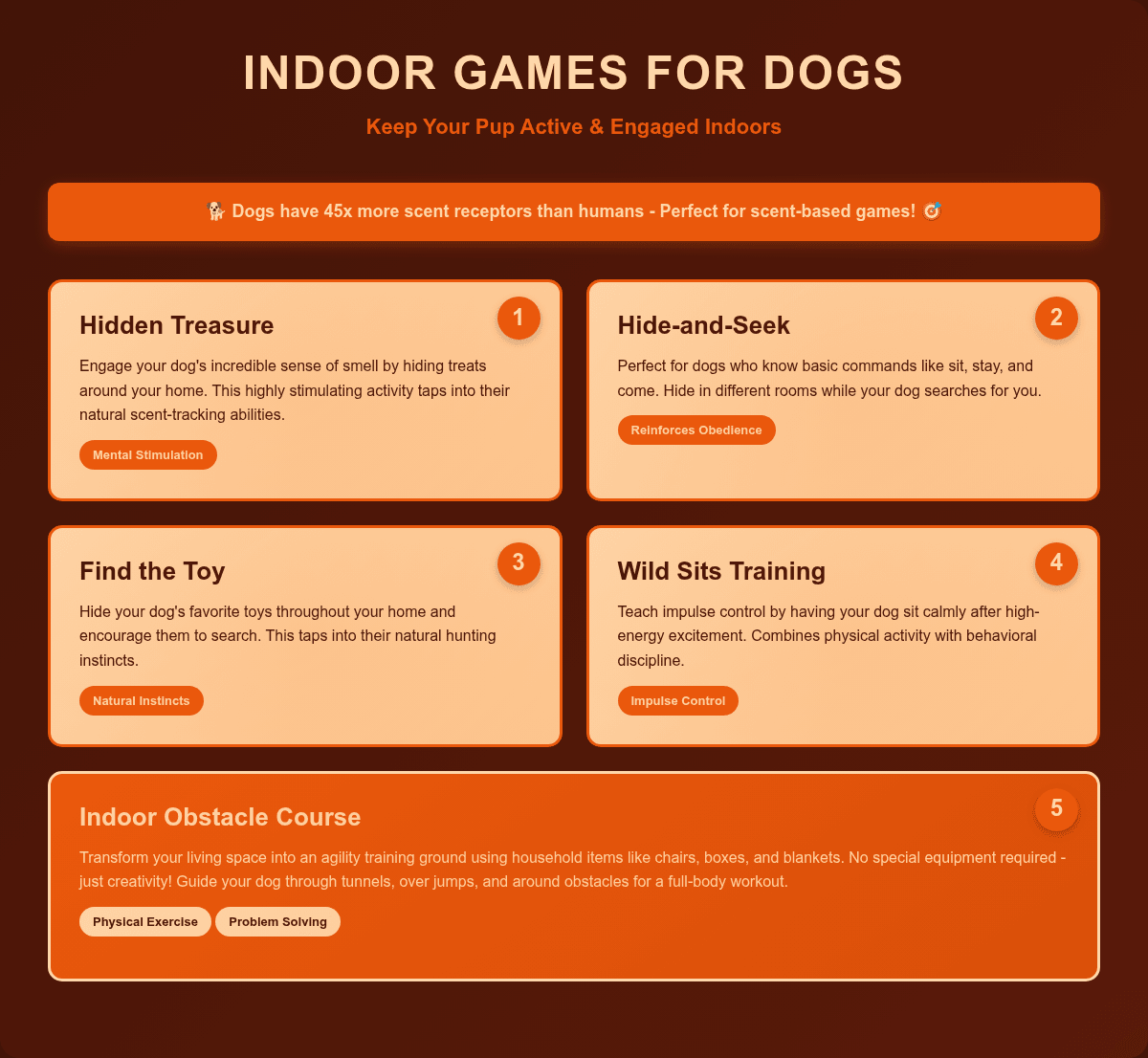
- Hidden treasure games engage your dog’s incredible sense of smell—dogs have approximately 45 times more scent receptors than humans, making scent-based activities highly stimulating
- Hide-and-seek works perfectly for dogs who know basic commands like sit, stay, and come, providing both mental stimulation and reinforcing obedience skills
- Indoor obstacle courses using household items like chairs, boxes, and blankets transform your living space into an agility training ground without requiring special equipment
- Wild sits training helps teach impulse control by having your dog sit calmly after high-energy excitement, combining physical activity with behavioral discipline
- Find the toy games tap into your dog’s natural hunting instincts by hiding favorite toys throughout your home and encouraging them to search
Overview
When rain pounds against the windows or summer heat makes outdoor play dangerous, you might notice your dog pacing restlessly or bringing you toys with those pleading eyes. Indoor confinement doesn’t just affect humans—our dogs feel that cabin fever too. Whether you’re dealing with extreme weather, recovering from an injury, or living in an apartment where outdoor space is limited, keeping your dog mentally stimulated and physically active indoors becomes essential for their wellbeing and your sanity.
The good news is that engaging indoor games for dogs don’t require expensive equipment or a massive living space. Your home already contains everything you need to create enriching activities that tire out your dog’s body and mind. These games address your dog’s natural instincts—from their remarkable sense of smell to their desire to chase, hunt, and problem-solve. The right indoor activities can actually provide deeper mental stimulation than a simple walk around the block, leaving your dog contentedly exhausted and satisfied.
Best Indoor Games for Dogs
Hidden Treasure: Scent-Based Challenges
Your dog’s nose is an extraordinary tool waiting to be exercised. According to the American Kennel Club, dogs possess approximately 45 times more scent receptors than humans, making them natural detection experts. This biological advantage means scent-based games provide intense mental workouts that exhaust dogs far more effectively than physical exercise alone.
The basic hidden treasure game requires minimal setup. Gather several small boxes or plastic containers and arrange them upside down on your floor. Place a high-value treat under one container while your dog watches, then encourage them to investigate. As they sniff each container, their excitement builds until they identify the correct one. Celebrate enthusiastically when they succeed and immediately reward them with the treat. Once your dog masters the basic version, increase the difficulty by placing the treat while your dog is in another room, or by adding more containers to the lineup.
Snuffle mats take this concept further by creating a more complex scent puzzle. These textured mats feature multiple pockets, folds, and hiding spots where you can conceal treats throughout the fabric. Your dog must use their nose and paws to work through the mat systematically, providing 10-15 minutes of focused mental engagement. For dogs who demolish their meals in seconds, snuffle mats also serve as excellent slow feeders that prevent digestive issues while satisfying their foraging instincts.
Hide-and-Seek: A Classic With a Canine Twist
Remember the thrill of finding the perfect hiding spot as a child? Your dog experiences that same excitement when searching for you throughout the house. This game works best for dogs who reliably respond to basic obedience commands like sit, stay, and come. Start by having your dog sit and stay in one room—asking another family member to gently hold them works if they’re still mastering the stay command.
Walk to another area of your home and find a hiding spot. Begin with easy locations like standing behind a door or sitting in an obvious corner. Once positioned, call your dog’s name enthusiastically to signal the game has begun. The moment they discover you, throw a small celebration with praise, pets, or treats. This positive reinforcement strengthens their recall response while making the game irresistible.
As your dog becomes more skilled, challenge them with progressively difficult hiding spots. Try crouching behind furniture, hiding in closets with the door slightly ajar, or even ducking into the bathtub behind a shower curtain. Some dogs develop impressive problem-solving skills, learning to check favorite hiding spots first or following scent trails through multiple rooms. The game naturally reinforces the come command in a fun, low-pressure context that builds reliability for when you really need them to respond.
Find the Toy: Indoor Treasure Hunting
This variation on hide-and-seek focuses on your dog’s favorite toy rather than you. The game capitalizes on your dog’s natural hunting and retrieving instincts while teaching valuable search skills. Start by ensuring your dog knows the name of at least one specific toy. Hold up their ball, rope, or squeaky toy and repeatedly say its name while playing together until they associate the word with that object.
Once the association is solid, have your dog sit and stay while you hide the toy somewhere in the room—under a cushion, behind a chair leg, or partially visible on a low shelf. Return to your dog and ask them to “find the ball” or whatever name you’ve taught them. Initially, hide the toy in relatively obvious places so they experience quick success. As their skills develop, create increasingly challenging scenarios that require them to search multiple rooms or check unusual locations like inside a shoe or tucked into a basket of laundry.
Tug-of-War: Controlled Strength Training
Despite old myths about tug-of-war creating aggressive dogs, this game actually provides excellent impulse control training when played with clear rules. According to the American Veterinary Medical Association, structured play strengthens the bond between dogs and owners while providing appropriate outlets for natural behaviors. Choose a sturdy rope toy or tug toy designed specifically for this purpose, ensuring it’s long enough that your hands stay safely away from your dog’s mouth.
The key to productive tug games lies in teaching your dog to release on command. Begin each session by establishing a release word like “drop it” or “give.” When your dog is holding the toy, stop pulling and hold the toy motionless while showing them a high-value treat. The moment they release the toy, mark the behavior with “yes” and deliver the treat. After several repetitions, your dog learns that releasing the toy isn’t the end of the game—it’s just a pause before more fun begins. This pattern teaches impulse control and ensures you maintain authority over the game’s pace.
During the game itself, allow your dog to “win” occasionally by releasing the toy so they can shake it triumphantly. This builds their confidence and keeps the game exciting. However, you should control when the game starts and stops, reinforcing that play happens on your terms. Brief tug sessions of 2-3 minutes followed by a release command provide intense physical engagement without overexciting your dog.
Wild Sits: Teaching Calm After Chaos
This brilliant training exercise addresses one of the most challenging aspects of living with an energetic dog—helping them transition from excitement to calmness. Wild sits work particularly well for high-energy breeds who struggle with impulse control. You’ll need a leash for this exercise, even though you’re indoors, as it helps you maintain control during the excitement phase.
Start by deliberately getting your dog excited. Run around the room with them, play with a toy, use an enthusiastic voice, or bounce around energetically. Let them feed off your energy until they’re properly wound up. Then, suddenly stop all movement and become completely calm. Stand still, stop talking, and wait. Your dog will likely continue bouncing around you, but remain perfectly neutral. The moment they sit—even briefly—mark the behavior with a calm “yes” and deliver a treat.
The magic of wild sits lies in the contrast between high energy and sudden calm. Your dog learns they can self-regulate their excitement levels, which translates to better behavior during real-world exciting situations like guests arriving or preparing for walks. Practice this exercise in short 5-minute sessions, repeating the excitement-then-calm pattern 3-4 times per session. Over time, your dog will sit more quickly after excitement, eventually learning to check in with you automatically when feeling overstimulated.
Indoor Obstacle Course: Home Agility Training
Transform your living room into an agility course using household items you already own. This activity combines physical exercise with mental problem-solving as your dog learns to navigate unusual challenges. The beauty of indoor obstacle courses is their infinite variability—you can create a new course every single day using different combinations of furniture and objects.
Start with simple obstacles: place a broomstick across two low chairs to create a jump, drape a blanket over your dining table to create a tunnel, or arrange couch cushions on the floor for your dog to walk over. Use treats or a favorite toy to lure your dog through each obstacle in sequence. Some dogs take to obstacles immediately, while others need patient encouragement and multiple exposures before feeling confident.
As your dog masters basic obstacles, increase the complexity. Create weave poles using water bottles or rolled towels spaced on the floor, build platform stations using sturdy boxes where your dog must pause and sit, or design balance challenges using a wooden board placed on top of a rolled yoga mat. Always consider your dog’s size, age, and physical capabilities when designing obstacles. Senior dogs or those with joint issues benefit from low-impact obstacles that emphasize mental rather than physical challenge.
Staircase Games: Vertical Exercise
For homes with stairs, these architectural features become excellent exercise tools. Stair games provide serious physical workouts in minimal space, making them perfect for draining energy quickly. The simplest version involves fetch on the stairs—stand at the bottom and toss a ball or toy to the top landing, then praise your dog as they race up to retrieve it and bring it back down.
Add variety by reversing the game and standing at the top while your dog waits at the bottom. You can also practice position commands on different steps—ask your dog to sit on step three, then move to step five and lie down, then return to step one for another sit. This variation combines physical exercise with obedience reinforcement. Never push dogs to use stairs if they show reluctance, as some dogs experience anxiety about stairs or may have physical limitations that make them uncomfortable.
Important Considerations
Before diving into indoor play sessions, understanding your dog’s physical and mental limits prevents frustration and potential injuries. Energy levels vary dramatically between breeds and individual dogs. A border collie or Jack Russell terrier requires significantly more mental stimulation than a bulldog or basset hound. Match game intensity and duration to your dog’s breed characteristics, age, and fitness level.
Watch for signs of overexertion during play. Heavy panting, excessive drooling, disorientation, or reluctance to continue all signal your dog needs a break. Indoor games, particularly on hard floors, increase injury risk compared to outdoor play on grass. Dogs can slip on hardwood or tile when making sharp turns during chase games. Consider placing yoga mats or rubber-backed runners in play areas to improve traction and protect joint health.
Mental exhaustion deserves as much attention as physical tiredness. Puzzle games and scent work tax your dog’s brain intensively, and too much mental stimulation can leave dogs feeling anxious or frustrated rather than satisfied. Most dogs benefit from 10-15 minute game sessions followed by rest periods, rather than marathon hour-long play sessions. Monitor your dog’s body language—if they start losing focus, walking away, or showing signs of stress like yawning or lip licking, end the session on a positive note.
Space constraints matter more for some games than others. Fetch in a narrow hallway works fine, but tug-of-war needs enough room that you won’t accidentally knock over lamps or furniture during enthusiastic pulling. Always remove breakable items from play areas before beginning active games. Some dogs become so focused on toys or treats during games that they lose awareness of their surroundings and can crash into furniture or walls.
Finally, consider your neighbors if you live in an apartment or share walls. Games involving jumping, running, or dropping toys can create significant noise for downstairs neighbors. Schedule active play during reasonable hours and choose quieter games like scent work or training sessions for early mornings or late evenings.
Indoor Games Comparison Table
| Game Type | Energy Level | Best For | Space Needed | Duration | Key Benefit |
|---|---|---|---|---|---|
| Hidden Treasure | Low-Medium | All dogs, especially scent hounds | Minimal | 10-15 min | Mental stimulation, uses natural sniffing instincts |
| Hide-and-Seek | Medium | Dogs with basic obedience | Multiple rooms | 15-20 min | Reinforces recall, builds bond |
| Find the Toy | Medium | Retrievers, hunting breeds | One or more rooms | 10-15 min | Problem-solving, object recognition |
| Tug-of-War | High | Strong, mouthy breeds | Small area (6×6 ft) | 5-10 min | Physical exercise, impulse control |
| Wild Sits | High | Hyperactive dogs, young dogs | Small area | 5 min sessions | Teaches self-regulation |
| Obstacle Course | Medium-High | Athletic breeds, agility-loving dogs | Full room | 15-20 min | Physical + mental, builds confidence |
| Stair Games | High | Healthy adult dogs | Staircase required | 5-10 min | Intense cardio, muscle building |
Frequently Asked Questions
What are the best indoor games for dogs on rainy days?
The most effective rainy day activities combine mental and physical stimulation to tire dogs thoroughly despite limited space. Scent-based games like hidden treasure work particularly well because they engage your dog’s most powerful sense while requiring minimal running space. Hide-and-seek throughout your home and indoor obstacle courses also provide excellent alternatives to outdoor play, keeping your dog engaged for 30-45 minutes of quality activity time.
How long should indoor play sessions last?
Most dogs benefit from 10-15 minute focused play sessions rather than extended periods of continuous activity. Mental games like puzzle toys or scent work are particularly tiring to dogs’ brains, so even short sessions create significant fatigue. You can conduct 2-3 separate sessions throughout the day, matching the total duration to your dog’s age, breed, and energy level—young working breeds may need 45-60 minutes total daily indoor activity, while senior or low-energy dogs might be satisfied with 15-20 minutes.
Can indoor games replace walks entirely?
Indoor games provide excellent supplemental exercise and mental stimulation but shouldn’t completely replace outdoor walks for most dogs. According to research from veterinary behaviorists, dogs benefit from outdoor environmental enrichment including new smells, sights, and social opportunities that indoor play can’t replicate. However, during extreme weather, illness recovery, or temporary circumstances, a combination of intensive indoor games, training sessions, and mental puzzles can adequately meet your dog’s exercise needs for short periods.
What indoor games work best for puppies versus senior dogs?
Puppies benefit most from games that combine training with play, like hide-and-seek with recall practice or gentle obstacle courses that build coordination and confidence. Keep puppy sessions brief (5-10 minutes) since their attention spans are shorter. Senior dogs thrive with low-impact mental challenges like scent work, hidden treasure games, and gentle training sessions that avoid jumping or intense physical demands while still engaging their minds and maintaining mobility within their physical capabilities.
Final Thoughts
The weather outside or your living situation doesn’t have to limit your dog’s quality of life. With creativity and the right approach, your home transforms into an enrichment center that satisfies your dog’s physical needs and mental curiosity. Start with one or two games that match your dog’s personality and energy level, then gradually expand your repertoire as you discover what they love most. The most important element isn’t the specific game you choose—it’s the focused, engaged time you spend together, strengthening your bond while keeping your dog happy, healthy, and mentally sharp even when outdoor adventures aren’t possible.
This article is for informational purposes only and does not substitute for professional veterinary advice. Always consult with your veterinarian before starting new exercise programs, especially for dogs with health conditions, joint issues, or those recovering from injuries.
Disclaimer: This article is for informational purposes only and is not a substitute for professional veterinary advice. Always consult your vet for your pet’s health concerns.
Source: www.akc.org