
Quick Summary
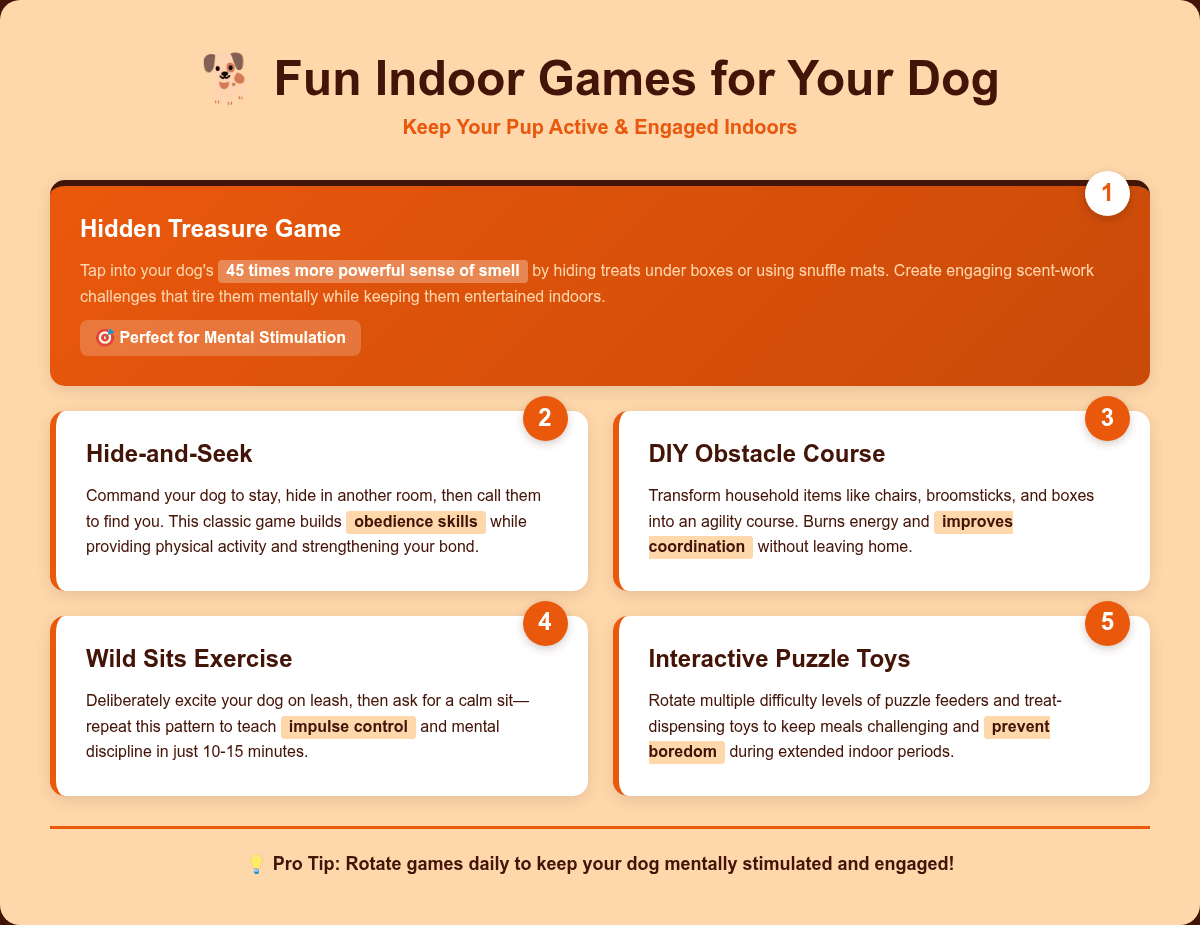
- Hidden Treasure Game: Use your dog’s 45 times more powerful sense of smell by hiding treats under boxes or using snuffle mats to create engaging scent-work challenges that tire them mentally
- Hide-and-Seek: Command your dog to stay, hide in another room, then call them to find you—builds obedience skills while providing physical activity and strengthening your bond
- DIY Obstacle Course: Transform household items like chairs, broomsticks, and boxes into an agility course that burns energy and improves coordination without leaving home
- Wild Sits Exercise: Deliberately excite your dog on leash, then ask for a calm sit—repeat this pattern to teach impulse control and mental discipline in just 10-15 minutes
- Interactive Puzzle Toys: Rotate multiple difficulty levels of puzzle feeders and treat-dispensing toys to keep meals challenging and prevent boredom during extended indoor periods
Overview
When rain pours down for days, winter storms lock you inside, or your dog is recovering from an injury, the walls can start closing in—for both of you. Your energetic companion paces by the door, and you feel that familiar guilt knowing they’re not getting their usual outdoor stimulation. The good news? Indoor games for dogs can be just as enriching, exhausting, and bonding as a trip to the park when done correctly. Dogs don’t just need physical exercise; they crave mental challenges that tap into their natural instincts. A twenty-minute session of brain games can sometimes tire a dog more effectively than an hour of mindless walking. Whether you’re dealing with extreme weather, a senior dog with mobility issues, or simply a busy day, having a repertoire of indoor activities transforms confinement from frustrating to fulfilling for your four-legged friend.
Best Indoor Games for Dogs
Hidden Treasure: Tapping Into Your Dog’s Superpower
Your dog possesses approximately 45 times more scent receptors than you do, making their nose an incredible tool that often goes underutilized when stuck indoors. The Hidden Treasure game channels this natural ability into an entertaining challenge that provides genuine mental exhaustion. Start by gathering three to five small boxes, cups, or containers and arranging them upside down on your floor. While your dog watches (or waits in another room for advanced players), place a high-value treat or favorite toy under one container.
The beauty of this game lies in watching your dog work through the problem methodically. Encourage them to investigate each container by sniffing rather than pawing or flipping them over immediately. When they correctly identify the treasure’s location through scent alone, celebrate enthusiastically and reward them with the hidden prize. As your dog masters this game, increase the difficulty by using more containers, placing them farther apart, or using boxes of different sizes and materials to create more complex scent pictures.
Snuffle mats offer a more advanced version of this concept. These fabric mats feature multiple pockets, folds, and hiding spots where you can conceal dozens of small treats. Your dog must use their nose and problem-solving skills to extract every morsel, turning a simple meal into a 15-20 minute mental workout. The American Kennel Club recognizes nose work activities as excellent outlets for a dog’s natural scenting abilities, making these games particularly valuable for breeds developed for tracking or hunting work.
Hide-and-Seek: A Childhood Classic Reimagined
Remember the thrill of finding the perfect hiding spot as a child? Your dog experiences that same excitement when playing hide-and-seek with their favorite person. This game requires your dog to understand basic obedience commands—specifically “sit,” “stay,” and “come”—making it both a training reinforcement tool and an entertaining activity. Lead your dog to a starting room and ask them to stay. If they’re still mastering the “stay” command, have another family member hold them gently or work in a room with a baby gate.
Once your dog is waiting patiently, move to another area of your home and find a hiding spot. Don’t make it impossible initially; standing behind a partially open door or ducking into a closet with the door cracked works perfectly for beginners. Call your dog’s name enthusiastically to signal they should start searching. As they move through the house trying to locate you, they’re exercising their problem-solving abilities, using their nose to track your scent trail, and getting physical activity navigating through rooms.
When your dog discovers your hiding place, make it the best moment of their day with praise, treats, and maybe a brief play session with a favorite toy. This positive reinforcement strengthens their recall response while building the bond between you. As your dog improves, challenge them with more difficult locations—under beds, behind shower curtains, or in rooms they must search more carefully.
Obedience Training Sessions: Structure Meets Stimulation
An indoor training session might not sound as exciting as a game, but dogs genuinely enjoy the mental engagement and one-on-one attention that focused obedience work provides. Whether you’re polishing skills for competition or simply reinforcing good manners, dedicating 15-20 minutes to training can tire your dog as effectively as a long walk. Choose one or two specific skills to focus on rather than overwhelming your dog with multiple concepts.
Work on duration sits and downs, practice heeling in your hallway, or introduce a new trick like “spin” or “play dead.” Retrieving exercises work particularly well indoors if you have enough space; teach your dog to fetch specific items by name, gradually building their vocabulary. An obedience-retrieving dumbbell provides excellent training opportunities, helping your dog understand holding objects gently and delivering them directly to your hand.
The key to successful indoor training lies in keeping sessions short, positive, and rewarding. According to research from veterinary behaviorists at major universities, dogs learn best in sessions lasting 10-15 minutes with clear success markers and immediate rewards. Multiple short sessions throughout a rainy day prove more effective than one exhausting hour-long marathon.
Wild Sits: Teaching Impulse Control Through Contrast
This brilliantly simple exercise teaches one of the most valuable skills any dog can learn: impulse control. The concept seems counterintuitive at first—you deliberately excite your dog as much as possible, then ask them to immediately calm down and sit. Attach a leash to your dog and begin running around, using an excited voice, quick movements, and maybe even squeaking a toy. Get them genuinely worked up and engaged in the chaos you’re creating.
Then, suddenly stop moving, stand still, and calmly ask for a sit. The contrast between the wild energy and the calm command creates a powerful learning moment. When your dog manages to collect themselves and sit despite their excitement, reward them generously. This exercise mimics real-world situations where your dog must control impulses—ignoring a squirrel on walks, settling when guests arrive, or remaining calm at the veterinary office.
Practice wild sits for just 10-15 minutes at a time, repeating the pattern of excitement followed by calm several times per session. You’ll notice your dog getting faster at transitioning from wild to controlled, demonstrating improved self-regulation that carries over into daily life.
Indoor Obstacle Course: Agility Without the Equipment
Transform your living space into an agility course using everyday household items. Chairs become weaving poles, a broomstick balanced on boxes creates a jump bar, and a tunnel made from a bedsheet draped over dining chairs provides crawling practice. Open cardboard boxes can serve as platforms for your dog to jump onto or through. This creative approach to agility training provides physical exercise, builds confidence, and strengthens your communication as your dog learns to follow your directional cues.
Start by introducing each obstacle individually, using treats to lure your dog through or over each element. Once they understand each component, begin linking them together into a sequence. Guide your dog through the course using hand signals and verbal encouragement, gradually increasing speed as they memorize the pattern. The mental processing required to navigate obstacles while following your directions creates genuine tiredness despite the limited space.
Change your course layout regularly to keep the challenge fresh. Organizations like the American Veterinary Medical Association note that varied physical activities help maintain joint health and coordination across a dog’s lifespan, making these indoor courses valuable for dogs of all ages when appropriately scaled to their abilities.
Interactive Puzzle Toys and Feeders
Rather than delivering meals in a traditional bowl, puzzle feeders transform eating into an extended problem-solving session. These toys come in various difficulty levels, from simple wobbling dispensers that release kibble as your dog pushes them around to complex multi-step puzzles requiring specific sequences to unlock treat compartments. A food-motivated dog might spend 20-30 minutes working through their breakfast when served in a challenging puzzle, providing mental stimulation that rivals physical exercise.
Rotate between different puzzle styles to prevent your dog from memorizing solutions and losing interest. Some puzzles require sliding panels, others involve lifting lids or spinning wheels, and advanced models combine multiple mechanisms. This variety keeps your dog’s mind engaged and prevents the frustration that comes from repeatedly failing at an overly difficult puzzle. Start with beginner levels and gradually increase complexity as your dog’s problem-solving skills improve.
Puzzle toys prove particularly valuable for high-energy working breeds that were developed to perform complex tasks. A Border Collie, Australian Shepherd, or German Shepherd often needs mental challenges even more than physical exercise, and puzzle feeders address that need effectively when outdoor herding or working opportunities aren’t available.
Important Considerations
Before diving into intensive indoor play sessions, consider your dog’s physical limitations and energy levels realistically. Senior dogs, puppies, and breeds with respiratory issues (like brachycephalic breeds such as Bulldogs or Pugs) overheat easily and tire quickly. What constitutes appropriate exercise for a young Australian Cattle Dog differs dramatically from suitable activities for a ten-year-old Basset Hound. Watch for signs of overexertion including excessive panting, reluctance to continue, or limping, and always stop before your dog becomes completely exhausted.
Space constraints matter more for some games than others. Wild sits and puzzle toys work in tiny apartments, while obstacle courses and vigorous hide-and-seek require more room to move safely. Assess your environment for hazards before encouraging running or jumping—slippery floors cause injuries, and sharp furniture corners become dangerous when dogs move quickly through spaces. Consider using yoga mats or rugs to create traction zones where your dog will be moving most actively.
Mental stimulation tires dogs differently than physical exercise, and it’s entirely possible to overstimulate a dog mentally just as you might overexercise them physically. Signs of mental fatigue include difficulty focusing, increased mistakes in familiar tasks, or stress behaviors like excessive yawning or lip licking. When you notice these signals, it’s time to end the session and allow rest.
The 90/10 rule provides helpful guidance for structuring your dog’s day. This principle suggests that dogs should spend approximately 90% of their time in calm, restful activities and only about 10% in high-energy exercise or stimulation. This might seem counterintuitive, especially for active breeds, but dogs naturally rest and sleep far more than humans—typically 12-14 hours daily for adult dogs. Overstimulation leads to behavioral problems including difficulty settling, reactive behavior, and stress-related issues. Your indoor games should provide quality engagement during that active 10%, followed by adequate downtime for processing and rest.
Comparing Indoor Game Types
| Game Type | Physical Intensity | Mental Challenge | Space Required | Best For |
|---|---|---|---|---|
| Hidden Treasure | Low | High | Minimal (any room) | Scent hounds, senior dogs, all ages |
| Hide-and-Seek | Medium-High | Medium | Multiple rooms | Dogs with solid recall, active breeds |
| Wild Sits | High | Very High | Small area | High-energy dogs needing impulse control |
| Obstacle Course | High | High | Larger open space | Athletic dogs, agility enthusiasts |
| Puzzle Feeders | Minimal | High | Single spot | Working breeds, food-motivated dogs |
| Obedience Training | Low-Medium | High | Minimal | All dogs, especially those learning new skills |
How to entertain your dog inside the house?
The most effective indoor entertainment combines mental stimulation with physical activity tailored to your dog’s breed, age, and energy level. Focus on games that engage your dog’s natural instincts—scent work for hounds, retrieving for sporting breeds, and problem-solving for working dogs. Rotate activities throughout the day rather than attempting one marathon session, and always end games before your dog loses interest completely. This approach keeps enthusiasm high and prevents boredom even during extended periods indoors.
What is the 90/10 rule for dogs?
The 90/10 rule suggests that dogs should spend approximately 90% of their time in calm, restful states and only about 10% in active exercise or high-stimulation activities. Despite appearances, dogs naturally rest 12-14 hours daily, and constant activity can lead to overstimulation, stress behaviors, and difficulty settling. This principle helps owners provide appropriate exercise without creating an adrenaline-junkie dog that struggles to relax. Structure your indoor games as focused, quality engagement periods followed by calm downtime rather than continuous stimulation throughout the day.
How long should indoor play sessions last?
Individual indoor game sessions should typically last 10-20 minutes for most dogs, with frequency depending on your dog’s age and energy level. Young, high-energy dogs might benefit from 3-4 brief sessions throughout the day, while senior or low-energy dogs may need only 1-2 shorter sessions. Watch your dog’s engagement level—when they start making mistakes on familiar tasks, showing distraction, or appearing tired, end the session positively. Multiple short, successful sessions create better learning and more thorough tiredness than one long, exhausting marathon.
Can indoor games replace outdoor walks entirely?
Indoor games provide valuable mental stimulation and moderate physical exercise but cannot completely replace outdoor walks for most dogs. Outdoor time offers irreplaceable benefits including exposure to natural sunlight for vitamin D synthesis, opportunities to explore novel scents and environments, and socialization experiences. However, during temporary situations like severe weather, illness recovery, or extreme heat, a combination of indoor games can meet your dog’s exercise needs adequately for short periods. Aim to return to outdoor activities as soon as conditions safely allow.
Final Thoughts
The rainy afternoon or snowbound weekend transforms from frustrating limitation to opportunity when you’ve mastered engaging indoor games that truly satisfy your dog’s needs. Remember that the seemingly simple act of asking your dog to find hidden treats or navigate a homemade obstacle course provides the mental challenge that many dogs crave even more than physical exertion. Start with one or two games that match your dog’s natural strengths—scent work for hounds, retrieving exercises for sporting breeds, agility courses for athletic dogs—and build your repertoire from there. Your dog doesn’t care whether enrichment happens in a park or your living room; they simply want focused attention, appropriate challenge, and time with their favorite person. That’s something you can provide regardless of what’s happening outside your door.
This article is for informational purposes only and does not constitute veterinary advice. Always consult with your veterinarian before starting new exercise programs, especially for dogs with health conditions, mobility issues, or behavioral concerns.
Disclaimer: This article is for informational purposes only and is not a substitute for professional veterinary advice. Always consult your vet for your pet’s health concerns.
Source: www.akc.org